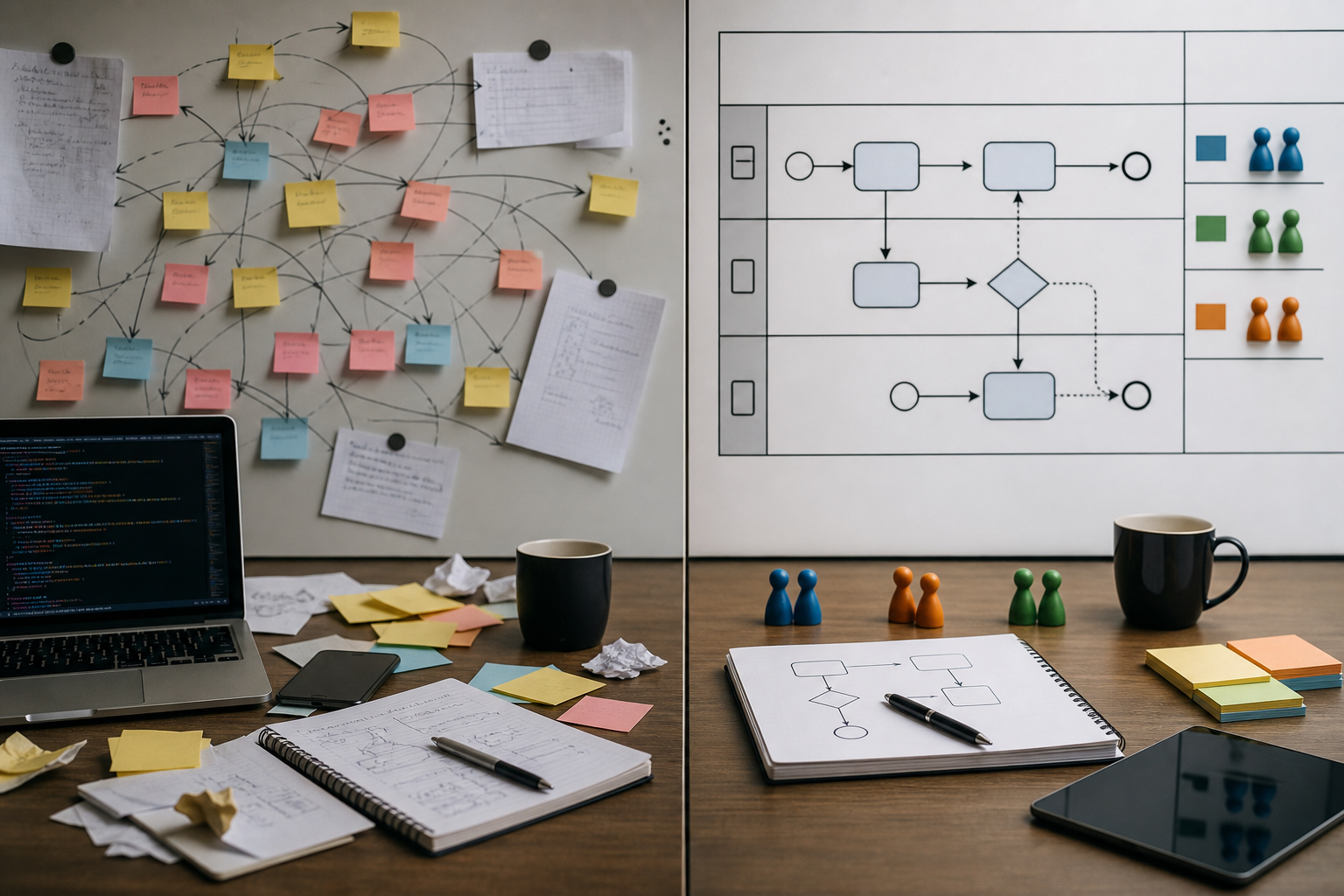
Disconnected work often starts as a coordination problem, then turns into a software problem.
A team can have good people and still struggle if the handoffs are unclear: one request lives in email, another in a ticketing tool, and the current version is the one someone remembers seeing last. Business process design is how you make that work visible before you automate it.
The BPMN standard is useful here because it creates a bridge between process design and implementation. The point is not to draw prettier diagrams. The point is to define the process in a way that can be reviewed, discussed, and then built without turning every exception into a support issue later.
That distinction matters because BPM, in the formal sense, covers discovery, design, and deployment. If you skip the first two, you usually end up encoding confusion into software. If you do them well, you can decide what should stay human, what can be automated, and where review belongs before the process goes live.
A practical rule: if a team cannot explain who owns each handoff, the process is not ready for automation. Start with the workflow as people actually use it, then model the exceptions, approvals, and integrations in plain language. BPMN gives structure to that conversation; it does not replace it.
That is the kind of foundation INOV8 LLC helps teams build when they need software that fits the work instead of fighting it.